




Australia
- Karawatha Forest (Karawatha)
Karawatha Forest contains some of the last remaining wet heathlands and melaleuca swamps in the Brisbane area. Locally-rare Eucalyptus grow on sandstone outcrops formed by continual cycles of mountain building and erosion over many millions of years. - Rainbow Valley Conservation Reserve (near Alice Springs)
The Rainbow Valley area features scenic sandstone bluffs and free-standing cliffs that form part of the James Range. Surrounding the range area, particularly in the northwest, are sand plains and a number of interconnecting claypans. - Royal National Park (near Sydney)
Established in 1879, Royal National Park is the world's second oldest national park—after Yellowstone in the USA. The park has one of the richest native insect faunas of any area in New South Wales.
England
- Dunwich Heath and Beach and Minsmere Reserve (near Dunwich, Suffolk)
Antlions are rare in England, found only in eastern Suffolk. According to the Wildscreen ARKive website, most colonies of the Suffolk antlion occur in the RSPB Minsmere Reserve, and more than 80% of the larvae occur in a restricted area not open to the public. But in the summer months the National Trust sponsors a holiday club at Dunwich Heath especially for children to learn about ecological issues. Activities include an antlion trek.
Because the English antlion population is so small, it is at potential risk for devastation due to human or other causes. Visitors to either location should take care not to disturb antlion colonies and should limit their antlion enjoyment to observation—not collection.
Estonia
- Tartu Noorte Loodusmaja (Tartu)
The Tartu Nature School offers nature activities for school children ages 6 to 18.
France
- Les Dunes des Charmes (à Sermoyer)
(Canton de Pont-de-Vaux)
These ancient sand dunes are of biological, geological and archaeological significance. In addition to providing an excellent habitat for antlions (fourmi-lion) and other creatures today, the site was home for humans in the Neolithic period (c. 8000 – c. 3500 B.C.E.).
Italy
- Poggio dell'Arena (Provincia Regionale di Caltanissetta)
This coastal nature preserve includes sand dunes where antlions (Formicaleone) can be found, in particular the species Palpares libelluloides.
South Africa
- Kruger National Park
Kruger is a vast wildlife preserve located in the northeast part of the country, along the border of Mozambique. While the park is more famous for its lions of the feline variety, antlions (nicknamed "shunties" by locals) are also readily seen there. - Mountain Sanctuary Park (near Magaliesburg)
Mountain Sanctuary Park is a privately owned nature reserve,
nestled in the Magaliesberg Mountains.
Spain
- Parque de la Sierra y Cañones de Guara (Huesca, Aragón)
This canyon park in northeast Spain is home to tarantulas and antlions (hormigas león). Information in English (Sierra y Cañones de Guara Nature Reserve). - Parque Natural de la Albufera (Valencia)
This natural park is located on the Mediterranean coast of Spain. - Playa de Uir (Gandia, La Safor region of Valencia)
Antlions can be seen in the sand dunes of this beach along the Mediterranean coast of Valencia.
Sweden
- Naturum Blekinge (Ronneby)
The Naturum is a wildlife center located in Brunnspark. It includes trails, walking tours and a nature preserve where antlions can be seen. The center is open June through August.
United States
- Albany Pine Bush Preserve (Albany, New York)
The Albany Pine Bush represents one of the best remaining examples of an inland pine barrens ecosystem in the world. - Bastrop State Park (Bastrop, Texas)
Site of the famous "Lost Pines," Bastrop State Park is an isolated timbered region of loblolly pine and hardwoods in eastern Texas. - Big South Fork National River and Recreation Area (Tennessee and Kentucky)
Encompassing 125,000 acres of the Cumberland Plateau, Big South Fork National River and Recreation Area protects the free-flowing Big South Fork of the Cumberland River and its tributaries. - Canyonlands National Park (Moab, Utah)
Canyonlands National Park preserves 527 square miles (848 square km) of canyons, mesas, buttes, fins, arches and spires in the heart of the Colorado Plateau in southeastern Utah. - Cape Henlopen State Park (Lewes, Delaware)
Located on the Atlantic coast, this large park is notable for its pine-covered dunes, ideal habitat for antlions. The park maintains several hiking trails and a nature center. -
Capitol Reef National Park (near Torry, Utah)
Capitol Reef National Park protects the Waterpocket Fold, a 100-mile long wrinkle in the earth's crust known as a monocline, which extends from nearby Thousand Lakes Mountain to the Colorado River (now Lake Powell). In May 2003 a reader reported that she found about 30 antlion pits at the trailhead to Hickman Bridge. - Chico Creek Nature Center and Bidwell Park (California)
Bidwell Park is a 3,618-acre municipal park that encompasses both sides of Big Chico Creek Canyon. Chico Creek Nature Center serves as the gateway and official information center for Bidwell Park. -
Crater Lake National Park (Oregon)
Located in southern Oregon on the crest of the Cascade Range, Crater Lake was formed after the collapse of an ancient volcano, posthumously named Mount Mazama. The park features 50 miles of hiking trails, an interpretive program and boat tours of the lake, from which rises Wizard Island. The 1933 Nature Notes from Crater Lake describe how antlions have adapted to this volcanic habitat. -
J.N. "Ding" Darling National Wildlife Refuge (Sanibel, Florida)
This refuge is located on Sanibel Island, a sub-tropical barrier island in the Gulf of Mexico, just off Ft. Myers, Florida. It protects over 7,000 acres of mangrove estuary, populated with large resident flocks of neo-tropical wading water birds and migrating waterfowl, as well as alligators, otters and raccoons. Antlions can be seen in the refuge's many sandy areas, especially along the Indigo Trail. -
Garner State Park (Concan, Texas)
Located along the Frio River, Garner State Park is part of a unique natural subregion known as the Balcones Canyonlands. The 1,420 acre park features deep canyons, streams, high mesas and carved limestone cliffs—rugged terrain that protects many vegetation and wildlife communities. -
Gibson Woods Nature Preserve (Hammond, Indiana)
Located in northern Indiana, Gibson Woods Nature Preserve consists of wooded sand dunes and small wetlands. Several rare and interesting animals can be seen here, including antlions. -
Hawn State Park (Ste. Genevieve, Missouri)
This park is located in the eastern Ozarks (south of St. Louis) and features a 10-mile backpacking trail through pine forests and along Pickle Creek and the River Aux Vases. -
Illinois
Beach State Park (Zion, Illinois)
Located north of Chicago along Lake Michigan, this park protects the only significant dune formations left in Illinois. In addition to an interpretive center in the nature preserve, there are several hiking trails along which antlions are easily spotted during spring and summer. -
Indiana Dunes National Lakeshore (Porter, Indiana)
This National Lakeshore runs for nearly 25 miles along southern Lake Michigan, and includes beaches, sand dunes, bog, wetlands, woodland forests. -
Indiana Dunes State Park (Chesterton, Indiana)
This park lies in northwest Indiana at the southern tip of Lake Michigan. The Nature Center's education program includes an "antlion safari" during which naturalist staff lead visitors onto the dunes to demonstrate how to find antlions in their natural habitat. Antlion safari hikes normally are scheduled in June and July. [Note: A five-minute documentary video excerpt of a safari is included on the educational DVD Antlion Safari, available for purchase from Swanson Media.]
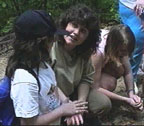
Naturalist Wendy Smith leads an "antlion safari."
© 1996 Mark SwansonThe Nature Center also has on display two spectacular antlion sculptures by artist Patrick Bremer.
-
Lake Roosevelt National Recreation Area
(Coulee Dam, Washington)
The Lake Roosevelt National Recreation Area contains a large section of the upper Columbia River in eastern Washington. - Massapequa Preserve (Long Island, New York)
Massapequa Preserve is 423 undeveloped acres of woodlands, ponds, lakes and freshwater wet-lands in Nassau County. The Preserve is home to hundreds of species of plants and animals. For more information, visit the Friends of Massapequa Preserve website. -
Medicine Lodge Wildlife Habitat Management Area
(Hyattville, Wyoming)
This wildlife area is located on the western side of the Big Horn Mountains at the mouth of Medicine Lodge canyon. In addition to a nature trail, the Area administers the Medicine Lodge State Archaeological Site, including several Native American petroglyphs and pictographs. -
Mesa Verde National Park (southwestern Colorado)
In addition to its ancient Puebloan cultural resources, Mesa Verde National Park also protects a rich diversity of wildlife, including over 1,000 species of insects and other invertebrates. Antlions can be found throughout the Park. - Mormon Island State Recreation Area (near Grand Island, Nebraska)
A local resident has reported finding many antlions under the bridges along interstate highway I-80 near Mormon Island SRA. - North Chickamauga Creek Gorge (near Chattanooga, Tennessee)
North Chickamauga Creek is a 7,093-acre natural area located in Hamilton and Sequatchie Counties. The gorge is approximately ten miles long with steep slopes, sandstone bluffs, and rich coves. A high diversity of plant and animal habitat exists in the gorge. For trail maps and other information, visit the North Chickamauga Creek Conservancy website. -
Palisades Interstate Park—New Jersey Section (Alpine, New Jersey)
Created to protect the famous Palisades of the Hudson, this park includes rugged woodlands and scenic views just minutes from midtown Manhattan. The 165-acre Greenbrook Sanctuary provides a variety of habitats for diverse plant and animal populations. Antlions can be found in the Alpine Picnic Area, near the Alpine Boat Basin and The Kearney House. -
Raven Rock State Nature Preserve (near Portsmouth, Ohio)
This nature preserve features a small natural arch ("Raven Rock Arch") located atop a cliff of Mississippian sandstone capping a 500-foot (150 m) high bluff overlooking the Ohio River valley. Antlions are found at the top of the cliff and at the base of a recess cave/rock overhang. Note: permits are required for access. -
Red River Gorge Geological Area (Stanton, Kentucky)
Located in eastern Kentucky, the Red River Gorge Geological Area contains the largest concentration of arches and rock shelters east of the Rocky Mountains. Within the area there are over 80 natural arches, historical sites, and miles of hiking trails. -
The Ridges Sanctuary (Baileys Harbor, Wisconsin)
Located in Door County, The Ridges Sanctuary is named for a series of beach ridges that harbor abundant antlion populations. The privately-owned sancturary is considered the most biologically diverse area in Wisconsin and is home to the federally-endangered Hine's Emerald dragonfly. -
Rio
Grande Nature Center State Park
(Albuquerque, New Mexico)
Located in the bosque along the Rio Grande, this park and wildlife refuge contains 270 acres of Cottonwood forest, meadows, and sand flats. Antlions can be found along the two miles of nature trails. The park features an excellent interpretive center and education program. -
Robert Cushman Murphy County Park (Brookhaven, Suffolk County, Long Island, New York)
Part of the Peconic River Watershed, the park is directly east of the Brookhaven National Lab. A reader provided these directions: "Enter at the access point at the intersection of Wading River and Shultz Road, then follow the trail westward to a pond. [In the summer of 2004] the trail was 'littered' with antlion pits all the way to the pond." - Rock Island State Park (near Washington Island, Wisconsin)
This primitive island is located off the tip of the Door County Peninsula, northeast of Washington Island in Lake Michigan. The park features about ten miles of trails with six miles of shoreline for hiking. Vehicles are not allowed on the 912-acre island, making for an experience unlike any other Wisconsin state park. -
Sleeping Bear Dunes National Lakeshore (Empire, Michigan)
A thirty-five mile stretch of Lake Michigan's eastern coastline, this park's natural features include forests, beaches, dune formations, and ancient glacial phenomena. - Louis Stelzer County Park (San Diego, California)
Stelzer Park includes 310 acres of oak woodland and coastal sage scrub. -
Trap Pond State Park (Sussex County, Delaware)
A mixed pine woods containing the northernmost range of Taxodium distichum (bald cypress) along the eastern coast of North America. -
Tyler Arboretum (Lima, Pennsylvania)
One of the oldest arboreta in the northeastern United States, Tyler Arboretum encompasses 650 acres of renowned plant collections, champion trees, historic buildings and 20 miles of hiking trails through woodlands, wetlands, and meadows. -
Yosemite National Park (California)
Yosemite National Park preserves almost 1,200 square miles of the central Sierra Nevada in eastern California. The park includes alpine wilderness, three groves of Giant Sequoias and the glacially carved Yosemite Valley. Naturalist John Muir writes in his book The Yosemite that he observed antlions on the northern (sunlit) side of the Valley even in the cold month of January.Books by and about John Muir can be purchased through The Antlion Pit Store.
Note: The U.S. National Park Service prohibits
the collection of insects in its parks. For more information on observing
insects in the wild, see the National Park Service article, "The
World of Insects and their Relatives."
| Have you seen antlions in a park or nature center not listed here? Send it to the editor using the Antlion Pit's contribution form. | 
|


 :
: