




Observing antlions in the wild
Capturing antlions
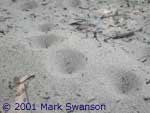
Antlions can be captured easily. With your hand, a spoon, or a small trowel, scoop out the entire pit with one steady motion, being careful to dig deep and wide enough so as not to crush the antlion, who is normally at the bottom-center of the pit. Let the sand sift through your fingers or pour it into a strainer to expose the animal. (The antlion larva might be difficult to spot at first because its gray-brown color often blends in with the soil.) When capturing an antlion in this manner you may discover the exposed antlion lying on its back, motionless, and apparently dead; wait a few moments and it will soon flip over and immediately begin its backward shuffle in an attempt to bury itself once again.
|


Do antlions bite humans?
If handled properly, antlions generally do not bite; however, like any animal, an antlion might bite if it feels threatened or stressed. The editor was bitten once when he allowed an antlion larva to crawl on the back of his hand. (Perhaps the editor's body hair alerted the antlion to its mammalian captor.) The injected poison caused a sharp burning sensation that lasted for several minutes after the antlion was shaken off, but it had no long-term effects.If you do handle an antlion with bare hands, stretch open your palm widely, creating a taut, flat surface with no skin folds for the antlion to grasp. If the antlion wanders toward the edge of your palm, transfer it gently to your other palm. Be sure to keep a thin layer of sand in your palm(s) to fool the antlion into thinking it is still on the ground. When you are finished, return the antlion to its home by holding your hand near the ground and angling it so that the creature falls gently to the sand. To prevent injury to the antlion or yourself, never pick up the antlion with your fingers.
Risks of taking antlions out of their habitat
Removing animals from their natural habitat is always a risky proposition. If you do decide to take an antlion larva home to study more closely, be prepared for the responsibility of feeding it (you'll have to catch the ants yourself). Put the antlion in any container filled with sand deep enough to allow the insect to build its pits—at least 3 inches (8 cm) deep. The container should also be wide enough to prevent overcrowding should you have more than one animal; allow at least 5 inches (13 cm) for each antlion. Twice-daily feedings will ensure that the animal survives.
A word of caution
The sooner you return antlions to the place you found them, the better off they
will be. Keeping an antlion past its larval stage is not recommended because
it might easily be forgotten and left to die (pupation occurs under the sand
and lasts about three weeks). If you do keep an antlion past the larval stage,
place
a stick upright in the sand so that the newly emerged adult has
a place to climb and rest while its wings expand and harden properly. Cover
the container with a ventilated lid or netting so that the adult won't escape—it
will almost certainly emerge from its cocoon when you're not watching. After
it emerges, return the adult antlion to its natural habitat as soon as possible
so that it can thrive and reproduce.
Note: The U.S. National Park Service prohibits the collection of insects in their parks, and some species of antlions in Germany [and perhaps other countries] have become endangered due to human destruction of habitat (Yasseri and Parzefall 1996). If you are not sure about the status of antlions in your region, err on the side of caution and simply enjoy these creatures in their natural environment.


 :
: